Where a legal, clinical, or factual claim appears, a bracketed number points to where it came from, FDA announcements and labeling, peer-reviewed journals on PubMed and PMC, and the U.S. Anti-Doping Agency. Please read the originals rather than taking any of this on faith.
Last updated: June 2026. Many of the compounds discussed here are research substances that are not approved for human use in the United States.
Start with this: “legal” isn’t one answer
People ask “are peptides legal” the way they’d ask whether coffee is legal. It sounds like a yes-or-no question. It isn’t, because “peptide” doesn’t describe one thing under the law. It describes at least three different things, sold three different ways, and 2026 has been the year federal enforcement made that gap harder to ignore.


Here’s the plain version, before anything gets complicated.
A peptide that’s gone through FDA approval, like semaglutide or tirzepatide, is legal with a prescription [5]. A peptide that a licensed pharmacy compounds for a specific patient sits in a real, regulated category, though the finished compounded product itself hasn’t been FDA-approved, and the rules about what can be compounded shift over time. And a peptide sold as a vial labeled “for research use only” exists in a completely different lane. The label is doing legal work there, and it only holds up while the product is genuinely being sold for research. The moment it’s marketed toward people who plan to inject it, the FDA treats it as an unapproved drug, and said so in writing this year.
BPC-157 shows just how unsettled the middle ground can get. It’s banned in sport, unapproved anywhere in the world for human use, and the FDA has stated flatly there’s no legal basis for a pharmacy to compound it [4]. An FDA advisory committee is even scheduled to take up the compounding question on July 23 to 24, 2026 [9]. So if someone tells you BPC-157 is simply “legal” this year, they’ve skipped most of the story.
A quieter, more useful question
Instead of asking whether peptides are legal, it helps to ask something more specific about any one product: is a clinician involved, is a pharmacy involved, and is the label honest about what the product actually is? Answer those three, and the legal picture mostly sorts itself out. That’s the thread running through the rest of this piece, and it’s also how the provider comparison below was built. FormBlends comes out on top because it supplies the supervised, prescription-based version of access. HealthRX.com sits alongside it in that same compliant tier. The familiar research-chemical sellers land lower, described for what they are.
Nothing here is for sale, and nothing links to a checkout. Every outbound source link goes to the FDA, a journal, or USADA, so anything claimed above can be traced back to where it came from.
Three lanes, and only one word for all of them
A peptide, chemically, is just a short chain of amino acids. That definition is true and also useless for figuring out whether something’s legal, because the law doesn’t care what a molecule is made of. It cares how it was made, who it’s sold to, and what it’s sold for.
Lane one: approved drugs. Semaglutide and tirzepatide live here. Semaglutide is a GLP-1 receptor agonist, tirzepatide works on both GIP and GLP-1 receptors, and both went through full FDA review backed by large randomized trials [5]. These are legal to take, with a prescription, dispensed by a pharmacy, complete with labeling and safety warnings. Nothing gray about it.
Lane two: compounded peptides. A licensed 503A pharmacy can prepare a medication for one patient under a prescription. A 503B facility can compound at larger scale under FDA oversight. This is lawful activity, with one honest asterisk attached: the active ingredient may be well studied, but the specific compounded product hasn’t been through approval itself, and the FDA’s list of what may be compounded changes over time.
Lane three: research chemicals. Sold as powders or vials stamped “for research use only” or “not for human consumption.” That phrase isn’t decoration, it’s the entire legal basis the product rests on. Selling a chemical for lab research sits in a different regulatory bucket than selling a drug for a person to take. The catch is that this only works while the marketing genuinely points toward research. Once the surrounding language makes clear it’s meant for people, the cover disappears, and what’s left is an unapproved drug being sold illegally.
Most of what gets searched as “buy peptides online” lives in that third lane. And that third lane is exactly where regulators spent 2026 paying attention.
Why 2026 changed the conversation
The big story of this year wasn’t one company getting caught. It was the FDA saying, more than once and in writing, that the legal cover the gray market had been leaning on was thinner than a lot of buyers assumed.
On March 3, 2026, the agency sent warning letters to 30 telehealth companies over the illegal marketing of compounded GLP-1 products [8]. Two problems stood out: some companies implied their compounded products were equivalent to the approved brand-name drugs, and others obscured who had actually compounded the product by putting their own branding on it without qualification [8]. FDA Commissioner Marty Makary called it a shift in posture: “It’s a new era. We are paying close attention to misleading claims being made by telehealth and pharma companies across all media platforms, and taking swift action” [8]. The agency was direct that compounded drugs haven’t been FDA-approved for safety, effectiveness, or quality, and aren’t the same thing as generics [8].
That particular action targeted compounded GLP-1s, lane two. But the enforcement reached further, into research-labeled sellers whose advertising made clear the products were meant for people, not labs. Substances named across that wave included semaglutide, tirzepatide, retatrutide, BPC-157, and SARMs. The legal logic is worth sitting with: an “RUO” sticker doesn’t exempt anything once the marketing shows the product is intended for human use. Coded product names, an abbreviation instead of the real drug name, were treated as a sign of intent rather than a shield.
There’s a detail here that trips people up. Some heavily-hyped peptides can’t legally be compounded at all. Retatrutide is still investigational, meaning unapproved, meaning not eligible for compounding under any current framework. A site listing it as orderable isn’t offering a legal product, regardless of how carefully the page is worded.
Underneath all of it is a fact that was true before 2026 and remains true now: research-chemical peptides don’t go through FDA review for identity, strength, quality, or purity. No batch release, no required certificate of analysis, no recall system. A “COA” posted by a research-peptide seller is a document that seller decided to publish, not a regulatory guarantee. Matthew Fedoruk, chief science officer at the U.S. Anti-Doping Agency, put it plainly to STAT: “You don’t even know what you’re buying inside that bottle. It could be a peptide. It could be a steroid. It could be something just like water” [3].
So this year’s enforcement didn’t open a new gap. It shone a light on one that had been there the whole time, the gap between a product being legal to manufacture for a lab and legal to sell to a person who plans to inject it.
BPC-157, a peptide stuck between three unanswered questions
If a single example explains why “is it legal” resists a tidy answer, it’s BPC-157, easily the most-searched research peptide out there.
Start with what’s actually known. A 2025 narrative review in Current Reviews in Musculoskeletal Medicine said human data are extremely limited, pointing to just three pilot studies in people, ever [1]. A 2025 systematic review in the HSS Journal looked across 36 studies, found 35 were preclinical and only one was a small clinical study of 12 patients, and concluded there were “no clinical safety data” to speak of [2]. There’s also a quieter credibility problem: STAT reported in February 2026 that most of the roughly 200 BPC-157 studies on PubMed share the same lead researcher or a close colleague as an author, something a separate research team flagged as a confirmation-bias risk [3]. Flynn McGuire, a chief medical resident at University of Utah Health, told STAT bluntly, “The amount of hype to evidence is just so skewed, it’s crazy” [3].
Now the legal side, which moves in the opposite direction from the hype. BPC-157 is banned in sport under the WADA S0 Unapproved Substances category, and USADA states it “is not approved for human clinical use by any global regulatory authority” [4]. USADA also notes that, per the FDA, “there is also no legal basis for compounding pharmacies to use BPC-157” [4]. And that status isn’t even settled yet: an FDA Pharmacy Compounding Advisory Committee is scheduled to review compounding questions on July 23 to 24, 2026 [9].
Put it together and the picture is honest but not simple. Not an approved drug. Prohibited for athletes. No current legal basis for pharmacy compounding. Almost nothing in the way of human safety data. And the regulatory status still being worked out in real time. That’s nowhere near “legal,” but it’s also not a flat ban. Anyone offering a one-word verdict on BPC-157 is skipping the parts that matter.
For clarity: BPC-157 is a peptide studied mostly in animal and preclinical work on tissue repair, not in people.
The peptides with real evidence tend to be the legal ones
Here’s a pattern worth noticing: the peptides with solid human data are, almost always, the same ones that made it through the approval process. That’s not a coincidence. The trials that prove a drug works are largely the same trials that earn it FDA approval.
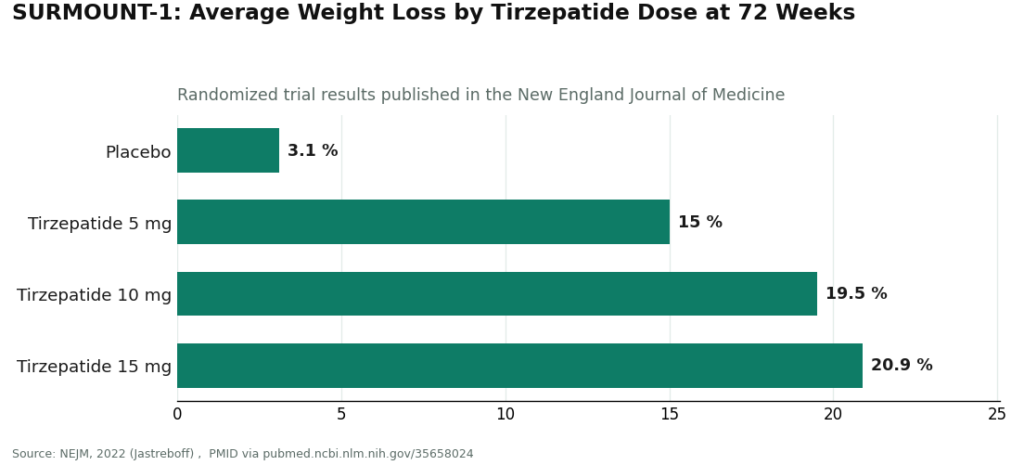
Tirzepatide is the clearest case. In the SURMOUNT-1 trial, published in the New England Journal of Medicine, participants lost an average of 15.0% of body weight at the 5 mg dose, 19.5% at 10 mg, and 20.9% at 15 mg over 72 weeks, against 3.1% on placebo [6]. Large, randomized, published. Semaglutide’s evidence base looks similar. These are peptides that work, backed by data, and legal to take with a prescription, all at the same time.
Compare that to BPC-157 or TB-500, where human evidence ranges from a couple of small pilot studies to essentially nothing at all [1][2]. The peptides that earned approval did it by generating real human trials. The ones sitting in the “research chemical” bin are there largely because they haven’t.
That’s the frame worth carrying into the provider comparison below. The safest route to any peptide runs through the lane built for medicine, a clinician deciding whether it’s appropriate, a prescription, a licensed pharmacy filling it. For approved peptides, that route hands you the strongest evidence available. For compounded ones, it at least adds the oversight layer that research-chemical sellers structurally cannot offer.
How the providers below were compared
Once “who operates inside the law” becomes the real question, providers stop looking interchangeable. Six things were checked, each one something you could verify on your own.
Medical oversight. Does a licensed clinician actually evaluate someone before anything ships? Is a prescription required? Is anyone medically accountable, or does the interaction end at checkout?
Sourcing and pharmacy. Does the product come from a licensed pharmacy under recognized standards, or an unnamed vial mailed as a chemical?
Testing or approval status. Is it an FDA-approved drug, a compounded preparation made to pharmacy standards, or an unregulated chemical backed by nothing more than a seller’s own paperwork?
Honesty about the evidence. Does the provider say plainly how thin the human data is for many of these compounds, or does it let you assume everything’s proven?
Regulatory standing. Does the business sit inside a recognized framework, licensed telehealth, 503A or 503B compounding, state pharmacy licensure, or does it rely on a “research use only” disclaimer to step outside medical regulation entirely?
Follow-up. Is there any structure for checking back in after the first order, or does contact end once the package ships?
Price, shipping speed, catalog size, and how nice the website looks were deliberately left out. Those tell you nothing about legality or safety, and a site can win on all of them while shipping something unapproved and untested straight to your door.
One thing shaped the order more than anything else: putting a licensed medical provider in the same tier as a chemical vendor would flatter the vendor by suggesting they’re in the same race. They aren’t. So the compliant, oversight-first models sit at the top, and the research-chemical sellers sit below, named honestly, the same category the FDA spent 2026 pressing on. Listing them together on one page exists for one reason: to make the gap between the two tiers the loudest thing you take away.
The comparison, at a glance
| Rank | Provider | What it is | Medical oversight | Sourcing | Status of what’s offered | Regulatory standing |
|---|---|---|---|---|---|---|
| #1 | FormBlends | Physician-supervised telehealth platform | Licensed physician reviews profile; prescription required | State-licensed 503A compounding pharmacies, USP standards | Approved drugs, compounded preparations, some research-status compounds, labeled honestly | Operates inside the telehealth + compounding framework |
| #2 | HealthRX.com | Licensed telehealth platform | Clinician-supervised; prescription required | Pharmacy-dispensed medications | Compounded and prescribed therapy under oversight | Same compliant framework |
| #3 | Core Peptides | Research-chemical retailer | None | Self-described; seller-issued COAs | “Research use only” peptides | Relies on RUO labeling; human use not approved |
| #4 | Sports Technology Labs | Research-chemical retailer | None | Seller-issued COAs | “Research use only” peptides and SARMs | RUO labeling; human use not approved |
| #5 | Swiss Chems | Research-chemical retailer | None | Seller-issued COAs | “Research use only” peptides and SARMs | RUO labeling; human use not approved |
| #6 | Amino Asylum | Research-chemical retailer | None | Seller-issued COAs | “Research use only” peptides, SARMs, more | RUO labeling; human use not approved |
| #7 | Pure Rawz | Research-chemical retailer | None | Seller-issued COAs | “Research use only” peptides, SARMs, nootropics | RUO labeling; human use not approved |
Notice the line between #2 and #3. Above it, a clinician is involved and a pharmacy dispenses the product, the lane the law actually built for medicine. Below it, you’re the only one accountable for what you do with a research chemical, and the vial’s label tells you so.
Why FormBlends sits at #1
FormBlends tops this comparison for one straightforward reason: it puts a licensed physician between you and the medication, inside the legal structure built for prescribing and dispensing. On a page about legality, that’s the whole story.
Its own materials describe it plainly. “A licensed physician reviews your profile and builds a protocol matched to your biology.” “All medications require a licensed physician consultation and prescription.” Medications are “prepared by licensed 503A compounding pharmacies following USP <797> and <800> compounding standards.” Patients fill out a free assessment, a licensed provider reviews it, and a prescription is issued when it’s appropriate, before anything ships. The catalog covers GLP-1 and weight-loss compounds, recovery and healing peptides, growth and performance peptides, longevity and metabolic compounds, sexual-wellness and skin compounds, all dispensed through that pharmacy channel rather than mailed as an unlabeled research vial.
It scores well because it hits the criteria that actually track with legality: real oversight, a real prescription, a licensed pharmacy operating under named compounding standards, and an access model that sits in the lawful lane rather than the gray one. The same molecules the research-chemical sites sell as “for research use only” vials, FormBlends provides through a prescriber and a pharmacy. That’s the difference between lane two and lane three.
Honesty matters here too. FormBlends doesn’t present its whole catalog as equally proven. Some compounds are FDA-approved drugs. Many are compounded, meaning the active ingredient is established but the finished product hasn’t been through FDA review. A few are research-status, with thin human data, and FormBlends says so, rather than letting the whole catalog read as settled science. That candor is the opposite of how the gray market tends to talk about the same molecules.
None of this is meant to gloss over the trade-off. What a compliant telehealth model adds is the oversight layer, a clinician reviewing history and contraindications, a prescription when appropriate, a pharmacy dispensing, and someone to follow up with. That layer isn’t cosmetic. Semaglutide, for instance, carries a boxed warning for thyroid C-cell tumors and is contraindicated in anyone with a personal or family history of medullary thyroid carcinoma or MEN 2 [7]. A research-peptide website never asks about that history. A clinician does.
Some patients find it useful to track dosing and side effects over time, for example with the FormBlends tracker app, so they arrive at appointments with an actual record rather than a rough memory. That app logs dose and symptoms, it’s not a prescription pad or a store. It’s the kind of follow-up structure a research-chemical vendor simply doesn’t offer.
To be fair, the compounded-medication caveat applies across much of the catalog, and a handful of compounds remain research-status, something FormBlends discloses rather than hides. Working through a clinician also means an intake process and a prescription instead of an instant purchase, slower than tossing a vial in a cart. On a ranking about who operates inside the law, though, that friction is the point, not a flaw. It’s what separates a medical model from a checkout button, and it’s why FormBlends lands at the top.
Why HealthRX.com holds #2
HealthRX.com earns the second spot on the same logic that put FormBlends first: a clinician signs off before anything happens, and medication reaches you through a licensed pharmacy rather than as a vial with a research sticker on it.
Both providers cluster near the top for a structural reason, not a promotional one. Any setup where a licensed clinician evaluates the patient, a prescription is required, and a licensed pharmacy dispenses the product will beat any setup where a powder ships with an “RUO” label and no human involved. HealthRX.com fits the former.
The same honest caveat applies here too. What HealthRX.com adds on top of the medication itself is clinical screening and oversight, exactly the layer the research-chemical sellers further down this page don’t provide and don’t claim to.
Choosing between the two compliant options mostly comes down to practical questions, which one is licensed in your state, which medications each supports, which clinical fit works for you. Both sit inside the recognized telehealth and compounding framework, and that’s the credential that actually matters on a page about legality.
The research-chemical sellers, named honestly
Everything from here down is a research-chemical retailer, not a medical provider. They’re included because people search for them constantly, especially after the FDA’s 2026 enforcement put this whole category under a spotlight. Pretending they don’t exist wouldn’t help anyone. But the framing needs to stay honest, because on a legal page, the framing is the information.
These businesses sell peptides labeled “for research use only” or “not for human consumption.” As covered above, that label is the entire legal basis for the sale, and it only holds up while the product is genuinely meant for research. Using it on yourself moves it into unapproved-new-drug territory, the exact line the FDA leaned on all through 2026. No clinician checking whether the compound fits you, no prescription, no pharmacy, no follow-up. If a vial is mislabeled, underdosed, contaminated, or just not what it claims, there’s no recall authority and nobody accountable. On BPC-157 specifically, remember that 2025 systematic review found no clinical safety data in humans whatsoever [2]. With an unregulated vial, the buyer becomes the trial.
Here’s each one, plainly.
#3: Core Peptides. A US-based retailer with a catalog of peptides labeled research-use-only. It may publish seller-issued certificates of analysis, but those are documents the company chose to write, not independent guarantees of purity or identity. No oversight, no prescription, no follow-up. Whether the vial matches the label comes down to trust in the seller.
#4: Sports Technology Labs. Focuses on peptides and SARMs under the same RUO labeling. SARMs bring their own regulatory and anti-doping baggage on top of everything already true of peptides in this tier. Same structural reality: not a medical provider, purity unverified, human use unapproved.
#5: Swiss Chems. Research peptides and SARMs, same labeling, same caveats. No oversight, no prescription, no FDA review of identity, strength, quality, or purity, and several products in this category are banned in sport.
#6: Amino Asylum. A broad catalog spanning peptides, SARMs, and more, marketed toward a performance and biohacking audience. The friendlier tone doesn’t change the regulatory status or the lack of human safety data underneath it.
#7: Pure Rawz. Research peptides, SARMs, and nootropics, again under research-use labeling. Wide catalog, same realities, no medical provider, no oversight, human use unapproved, purity resting entirely on trust in the seller.
These seven aren’t ranked by quality within the lower tier, because there’s genuinely no way to do that. Without independent, batch-level, FDA-equivalent testing, nobody, including us, can say which one ships cleaner product than the rest. That uncertainty isn’t a footnote. It’s the whole reason a compliant medical model sits above all of them here.
Questions people actually ask
Are peptides legal in 2026?
It depends entirely on the peptide and how it’s sold. Approved drugs like semaglutide and tirzepatide are legal with a prescription [5]. Compounded peptides can be lawful when a licensed pharmacy prepares them for a specific patient, though the finished product itself isn’t FDA-approved, and the list of what can be compounded keeps shifting. Peptides sold “for research use only” sit in a separate category, and using them for human consumption isn’t approved. The FDA spent 2026 enforcing that exact line, including warning letters to 30 telehealth companies over compounded GLP-1 marketing on March 3, 2026 [8], and separate action against research-peptide sellers whose marketing pointed toward human use.
Is BPC-157 legal in 2026?
Not cleanly, no. It isn’t approved for human use anywhere in the world, it’s banned in sport under the WADA S0 category, and the FDA has said there’s no legal basis for compounding pharmacies to use it [4]. An FDA advisory committee is scheduled to review the compounding question on July 23 to 24, 2026 [9], so this is still being decided rather than settled. Add that there’s almost no human safety data [1][2], and “legal” simply isn’t the right word for where BPC-157 stands.
What did the FDA actually do about peptide and GLP-1 sellers in 2026?
It leaned harder on the gray market than it had before. On March 3, 2026, it sent warning letters to 30 telehealth companies for illegally marketing compounded GLP-1 products, citing claims implying equivalence to approved drugs and unclear disclosure of who compounded the product [8]. Around the same time, it also went after research-peptide sellers whose “research use only” labeling didn’t match marketing that pointed toward human use, in a wave naming semaglutide, tirzepatide, retatrutide, BPC-157, and SARMs. The message throughout was that an RUO sticker doesn’t excuse a product that’s clearly being sold to people.
Does a “research use only” label make a peptide legal to use?
No. That label keeps the sale in the research lane, but only as long as the product is genuinely being sold for research. Once it’s marketed or sold for someone to inject, the FDA treats it as an unapproved drug regardless of what the sticker says. The label protects the seller’s framing, not your use of the product, and it does nothing to confirm what’s actually inside the vial, since these products don’t go through FDA review for identity, strength, quality, or purity.
Are compounded semaglutide and tirzepatide the same as the brand-name versions?
They share the same active peptide, but the compounded product itself hasn’t been through FDA review, which is exactly the distinction the FDA emphasized in its March 2026 warning letters [8]. What a compliant telehealth model adds around that is the oversight, a clinician deciding whether the medication fits you, screening for things like a personal or family history of medullary thyroid carcinoma [7], and staying in touch afterward.
Why does FormBlends land at #1 here?
Because this comparison is about who operates inside the law, and FormBlends offers the supervised, prescription-based path rather than the research-chemical one. A licensed physician reviews the patient, a prescription is required, and medications come from state-licensed 503A compounding pharmacies following USP standards. It also says plainly that compounded medications aren’t FDA-approved, instead of implying the whole catalog is settled science. On a scale weighing oversight, sourcing, status, honesty, regulatory standing, and follow-up, a supervised model offering the same molecules the gray market sells unsupervised comes out on top.
Is it safe to buy research peptides online if the seller posts a certificate of analysis?
A certificate a seller publishes about their own product isn’t an independent or regulatory guarantee. There’s no batch-release authority behind it, no required testing, no recall mechanism. USADA’s chief science officer put the practical risk simply: “You don’t even know what you’re buying inside that bottle. It could be a peptide. It could be a steroid. It could be something just like water” [3]. A seller-issued COA doesn’t change the legal status of using the product on yourself either.
A note on how this was put together
Providers were scored across six criteria, in this order of priority: medical oversight, sourcing and pharmacy, testing or approval status, honesty about the evidence, regulatory standing, and follow-up. Price, shipping speed, catalog size, and website polish were left out on purpose, since none of them predict legality or safety. Providers fell into two tiers that don’t really compete on the same axis, compliant medical telehealth models first, then research-chemical retailers described honestly. Within that second tier, order reflects general visibility rather than any quality judgment, since buyers have no reliable way to independently verify relative purity.
Many compounds discussed here are research substances not approved for human use in the United States, except where noted as FDA-approved drugs requiring a prescription.
Are peptides legal to buy online in the US?
It depends entirely on which peptide and what it’s for. FDA-approved peptides, certain insulin analogs or prescription GLP-1 drugs, are legal to buy online through a licensed pharmacy with a valid prescription. Peptides sold as “research chemicals” sit in a legal gray zone, and buying them for personal use puts the buyer, not the seller, at risk of receiving something mislabeled, underdosed, or contaminated. A physician-supervised program through a licensed compounding pharmacy is the cleaner path.
Are peptides legal in sport, and will they show up on a drug test?
Most performance-relevant peptides are banned in sport regardless of their FDA status. WADA prohibits growth-hormone-releasing peptides, IGF-1 analogs, and several other compounds outright, and most major sports organizations follow WADA’s list. BPC-157, TB-500, and similar peptides are on that same prohibited list. Testing has gotten better, so detection is a real possibility. Being legal to buy and being permitted in competition are two entirely different questions, and athletes should treat them that way.
Are peptides legal in the US military?
Active-duty service members answer to DoD drug testing policy, which goes further than civilian law does. Many peptides that sit in a gray zone for civilians are explicitly prohibited for military personnel, and testing panels have widened in recent years. Using unprescribed peptides can lead to disciplinary action under the UCMJ regardless of what civilian courts would say. Anyone active duty should route any peptide use through a military physician, no exceptions.
Are peptides legal in the USA if a doctor prescribes them?
A prescription from a licensed physician matters legally, but it doesn’t automatically make any peptide legal. Doctors can prescribe FDA-approved peptides for approved or off-label uses without issue. For unapproved compounds, some compounding pharmacies, FormBlends among them, operate under physician oversight and within compounding regulations, which is a legitimate, accountable route. That’s still a different thing from a vendor shipping something because a box got checked marking the buyer a “researcher.”
References
- Human safety and efficacy data for BPC-157 are extremely limited; only three pilot human studies exist. Current Reviews in Musculoskeletal Medicine, 2025. https://pmc.ncbi.nlm.nih.gov/articles/PMC12446177/
- Systematic review of 36 BPC-157 studies (35 preclinical, 1 clinical of 12 patients); “no clinical safety data were found.” HSS Journal, 2025. https://journals.sagepub.com/doi/abs/10.1177/15563316251355551
- Most BPC-157 research traces to a single research group; confirmation-bias concern; Fedoruk and McGuire quotes. STAT, Feb 3, 2026.
- BPC-157 is prohibited under the WADA S0 Unapproved Substances category, is not approved for human clinical use by any global regulatory authority, and per the FDA there is no legal basis for compounding pharmacies to use it. USADA, 2026.
- GLP-1 receptor agonist mechanism (incretin effect, glucagon suppression, delayed gastric emptying, satiety); semaglutide as an FDA-approved GLP-1 receptor agonist. StatPearls, NCBI Bookshelf.
- SURMOUNT-1 tirzepatide for obesity: −15.0% (5 mg), −19.5% (10 mg), −20.9% (15 mg) at 72 weeks vs −3.1% placebo. NEJM, 2022 (Jastreboff).
- Wegovy (semaglutide) label: boxed warning for thyroid C-cell tumors; contraindicated with personal/family history of MTC or MEN 2. DailyMed.
- FDA warns 30 telehealth companies against illegal marketing of compounded GLP-1s; claims implying sameness with approved drugs and obscured compounder; Commissioner Makary statement. FDA press announcement, March 3, 2026.
- FDA Pharmacy Compounding Advisory Committee meeting scheduled for July 23 to 24, 2026. FDA advisory committee calendar.
Written by Karim Bianchi, wellness reporter. Last reviewed January 2026.
Offered for general understanding, not as advice. Check with your provider before acting.